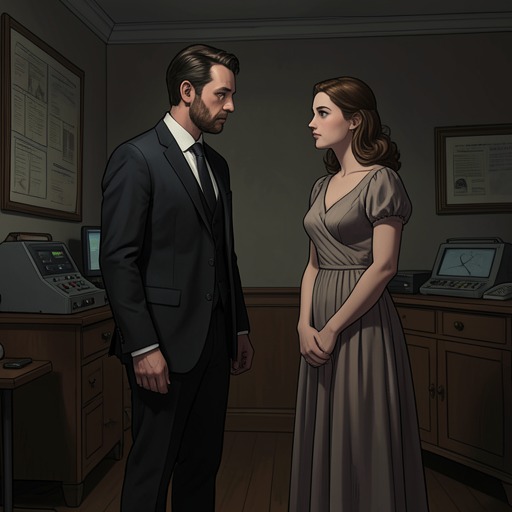
Graham Dunne and Karen Karen
Daisy Jones & the SixGraham Dunne and Karen Karen’s relationship joins musical respect to private romantic attachment, developing inside The Six without becoming part of the band’s public image. Karen joins as a musician who wants to be valued for her playing, not treated as a sexual opportunity; Graham is drawn to her both as a talented bandmate and as a woman. Their movement from flirtation to intimacy is decisive, but the relationship’s shape is equally visible in the quiet life they build away from the group: a house in Laurel Canyon, shared music, late nights out, and a secret kept even from Billy Dunne.
Musical Partnership and Mutual Regard
Karen’s place in the band begins with what she contributes musically. Graham recognizes that her presence gives the Winters’ sound an extra layer of lushness, and he and Billy gradually come to feel that the group does not merely need someone like Karen: it needs Karen herself. Graham later describes her as a great addition who made everything better, putting her ability first even as he acknowledges her beauty. The distinction matters to Karen. She had left the Winters because she was tired of bandmates trying to sleep with her; what she wanted was to be a musician.
Graham’s attraction does not erase that distinction. Karen knows he likes her looks, but she also believes he values her talent just as much, and his interest therefore does not unsettle her in the way the unwanted advances in her former band had. She finds him attractive in turn, especially for the combination of a rough-edged appearance and gentleness that she prefers. Her attraction is specific rather than based on the public appeal attached to Billy: she is drawn to Graham’s broad, rugged presence and the gentleness she sees beneath it. The relationship begins in a band where her musical standing and her desirability are both apparent, but not interchangeable.
That respect also appears in Graham’s wish to give Karen a vocal opportunity. While the group is working on “Honeycomb,” he thinks she should try the duet because she has a great voice. Karen declines the lead, explaining that she does not think her voice can carry that part and offering instead to support the chorus. Her response shows that intimacy does not make her automatically accept Graham’s proposal or his praise. She assesses her own ability and sets a limit; Graham’s admiration remains part of a working partnership as well as a romantic one.
From Teasing to Intimacy
The relationship turns during the band’s time in Glasgow, through a small, deliberately playful encounter rather than a formal declaration. Graham brings Karen a suitcase that has become mixed in with his belongings. At her hotel-room door, he is holding a duffel bag of her bras and underwear. Karen jokes that he must enjoy having his hands on her things. Graham answers that, if he ever does, he wants to have earned that intimacy the old-fashioned way. Karen laughs him off, and he leaves the exchange at that.
Later, a phone conversation makes the attraction explicit. Karen asks why Graham has never made a move on her. He answers that he does not take shots he knows he will miss. Karen tells him she does not think he will miss. The call ends abruptly, but Graham immediately runs down the hallway to her room. When she opens the door, he is out of breath. He asks what she is saying to him; she tells him to go for it. He enters, shuts the door, and kisses her. Their earlier banter had tested the possibility of intimacy; this exchange turns the test into mutual consent and action.
Graham remembers that day as one of the most exciting of his life. His recollection gives the beginning of the romance the force of a sudden change in an otherwise familiar band routine: a phone call becomes a run down the corridor, and an uncertain flirtation becomes a kiss. Karen’s direct invitation is essential to the turn. Graham does not have to guess whether her teasing is permission; she tells him plainly what she wants.
A Private Life Within the Band’s Success
As the group prepares to come together again for a new album, Graham takes on more of the organizing work while Billy’s attention is elsewhere. Karen, meanwhile, uses the money coming in to make a practical decision: she goes house-hunting with a realtor for a day, finds a place in Laurel Canyon, and buys it. Graham soon moves in unofficially. The shared home marks a change in scale from a hallway encounter or a hotel-room kiss to an everyday life arranged around the two of them.
They spend the spring and summer together at the house. Karen recalls dinners grilled on the patio, going to shows every night, and sleeping late in the mornings. Graham remembers whole weekends spent high, playing songs together, and telling no one where they were or what they were doing. He does not even tell Billy. The secrecy is explicit, but the remembered life is not presented only as concealment: Graham describes it as a time when the world seemed to stop for him and Karen. Music, leisure, and privacy gather into a temporary refuge from the band’s expanding demands.
The contrast with the group’s operation is sharp. Billy trusts Graham to handle band matters and believes they are in good hands, while Graham is also keeping his relationship and much of his private time with Karen to himself. Their romance thus exists alongside trust within The Six, but is not fully disclosed within it. The evidence presents this secrecy as part of their shared life, not as a public rupture or a stated conflict between the couple.
The Relationship Beside the Public Image
The Aurora cover shoot offers a later glimpse of Graham’s attachment in the midst of the band’s rising visibility. The photographer recalls the seven members standing together in the Santa Monica Mountains, with the road, dust, cliff, and sun contributing to the image’s distinctly Californian character. Graham remembers the day from another angle: he is on a mountaintop with the woman he loves, making a cover for an album everyone expects to become a major hit. His memory holds happiness and foreboding together; he cherishes the day, while recognizing that good fortune can be followed by calamity.
The cover’s most charged image is not a portrait of Graham and Karen. The photographer catches Daisy Jones looking toward Billy, then captures the instant Billy turns and meets Daisy’s gaze. This is the moment the photographer considers strong enough to anchor the cover. The contrast clarifies how the relationship between Graham and Karen occupies a different register from the band’s public mythology: Graham carries his love for Karen into the scene, while the photograph fixes attention on the exchange between Daisy and Billy. The group’s image can contain Graham’s private happiness without making it its visible subject.
The photograph later becomes culturally influential for reasons beyond the band’s music. Elaine Chang emphasizes Daisy’s self-possession in the image, and recalls the cover as a reason she fell in love with Daisy. That public reading does not define Graham and Karen’s relationship, but it underscores the gap between private attachment and the meanings audiences make from a band’s image. Graham remembers the shoot through the woman he loves; the finished image and its reception direct attention elsewhere.
Significance and Limits of the Record
Graham and Karen’s relationship is distinguished by the way it rests on recognition before romance. Karen is determined to be a musician rather than an object of bandmates’ pursuit, and Graham’s admiration includes her talent. Their courtship proceeds through jokes, hesitation, and an unmistakable invitation, after which a kiss gives way to a domestic life with its own routines and shared musical pleasure. In the group’s history, Karen is not simply Graham’s love interest: she is a valued musical addition whose independence and judgment remain apparent within the relationship.
The relationship also provides a private counterpoint to The Six’s collective story. Graham can be entrusted with band responsibilities while keeping his life with Karen undisclosed; the house in Laurel Canyon becomes a place for two people to play music and withdraw from the group’s circulation. At the album-cover shoot, that private attachment persists beside a public image whose central look belongs to Daisy and Billy. The available account leaves the relationship’s eventual outcome unstated. What it does establish is a period of mutual attraction, chosen intimacy, and shared life, remembered by Graham as both a rare pause and a happiness shadowed by what may come next.